I Miss Our Hummingbirds
Oh, The Beautiful Hummingbirds
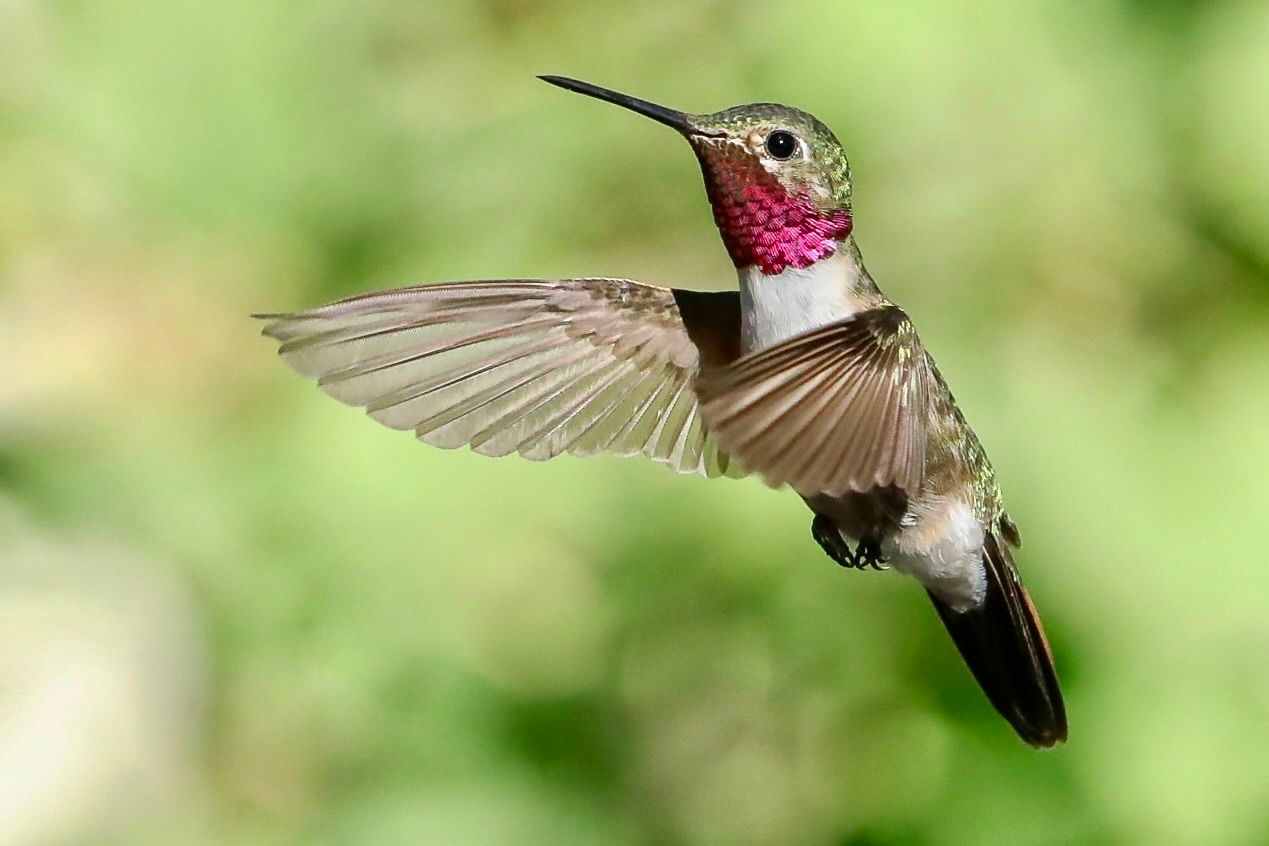
By now, sadly, most of us have taken down the sweet nectar of our hummingbird feeders. Oh, the beautiful hummingbirds. Those tiny, energetic birds known for their shimmering, jewel-toned feathers and wings that beat like a fan on ultra-high. So much so they create a humming sound.
My wife and I enjoy hummingbirds, the way they flitter about with their microscopic feathers reflect light, creating brilliant, iridescent colors like emerald green, ruby red, or rich violet. To draw them in, every summer Carolyn puts out feeders of sugar-water to attract and feed the smallest of birds who range from 3 to 4 inches long, weighing less than a nickel.
Plus, their unique shoulder joints let them rotate their wings nearly 180 degrees allowing them to stay completely still in mid-air. They are the only birds that can fly backward, upside down, and side-to-side, flapping their wings up to 80 times per second. So danged fast, they fly like a kite on a string during a windy fall day.
So when I sit on our deck, the sun at my back and camera in hand, I try to capture pictures of them flittering about. But they create a photographer’s challenge. Not only are their wings fast, but they fly up to 30 mph, and when mating, their courtship dives can reach 60 mph. I challenge you to try photographing a four inch long hummingbird flying at 30 mph with its wings flapping 80 times per minute as it quickly moves in any direction.
With this extreme energy, their hearts can beat over 1,200 times per minute to achieve the physical demands of flight. That’s how my heart beats when I try to capture them with my camera. My fluttering heart reminds me of waiting for a “yes” the first time I asked Carolyn on a date. A hummingbird’s heart might outdo mine, but not by much.
A common hummingbird summering in Colorado is the broad-tail hummingbird. The colorful males have shimmering green backs and a striking rose-red or magenta throat. Earlier this summer, it was a male broad-tail that snuck into our house.
Slipping through an open door, he hid among the tines of our moose antler chandelier. From there, he avoided every effort of the swishing broom I was shooing him with. The hummingbird turned me into a man of erratic, uncoordinated dance moves chasing a fast, flying pinball. Think of pac-man trying to eat dots that move like flies near a flame. I was getting burned by the competition.
As a hummingbird hunter, I portrayed a comedy of errors. Once, when he landed on the broom bristles, I took three steps toward the door. Then at 30 mph, he was lightning fast and gone, back to perch on an antler tine. After much time and intellectual thought, I changed my tactics. I retrieved one of the hummingbird feeders from the deck. Holding it high, sugar-water splatting gooey stains over the hardwood floor. I waited until finally the broad-tail came to feed.


As he fed, I walked as slowly as a tourist driving over the top of Trail Ridge Road. Step-by-step, inch-by-inch, I made it halfway to the door. Then either done feeding or sensing danger, the hummingbird’s rapid wings pulled him away. He hovered for a moment, their swish, he was back to the antler chandelier.
Discouraged but patient, I stood unmoving, a Statue of Liberty holding a sticky hummingbird feeder, liquid sugar running down my arm. I was going to outwit this miniature sized creature. Hummingbirds are remarkably smart, possessing an oversized brain relative to their body size that functions like a high-speed ecological genius, and I was striving to outsmart this minuscule bird weighing 16,818 times less than me.
It was only a moment or two until the desire for sugar brought him back to the feeder. All the while I stood unmoving until, with its long, thin, needle-like bill and forked tongue, he was once again drinking sweet nectar.
Slowly I moved, like Igor in
Young Frankenstein, step-by-step, inch-by-inch until I reached the back door. Stopping, the hummingbird hovered inches away, but I did not move. Then he was back to the nectar, its long, skinny beak drawing nutrients from the feeder. Reaching the feeder outside, I slowly closed the door with only my arm stretching into the slight breeze.
With that, the broad-tail was off flying to another feeder, and despite my sugar-water bath, I was proud of my success. Fly free my friend.
So the hummingbirds have now left my antler chandelier, our deck sugar-water feeders, and the wildflowers of mountain life for their migration to their winter condos in the highlands and coastal regions of
Mexico and South America.
As for Carolyn and I, in January we’re migrating to Bucerias, Mexico for 80 degree weather where I’ll photograph wintering humpback whales and the rare blue-footed booby. And, of course, I will enjoy capturing images of broad-tailed hummingbirds hovering around Carolyn’s sugar-water feeders from our tropical deck by the ocean.